


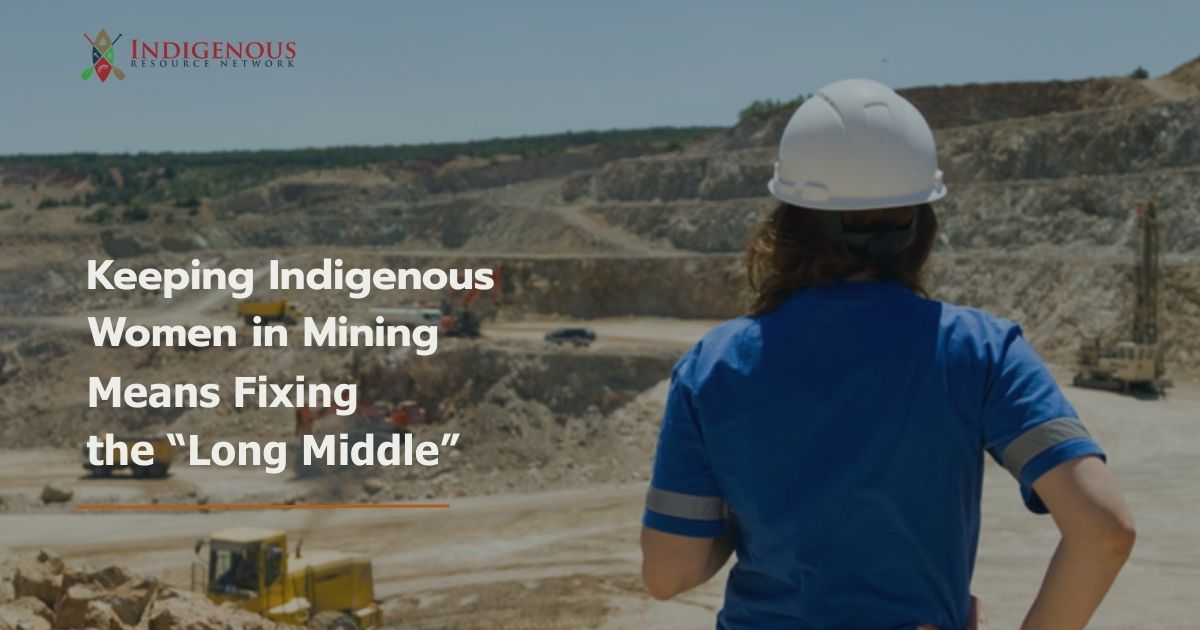
Keeping Indigenous women in mining requires more than hiring targets - it requires systems that support them through the long middle of a career. That means better visibility into participation, healthier remote work environments, and pathways to advancement that respect family, community, and long-term leadership.
Originally published by The Prospector News on 02/28/26: https://theprospectornews.com/the-march-april-2026-edition-of-the-prospector-news-is-available-for-download/mar-2026-tpnm/
Canada’s mining sector has made real efforts to bring more women in but the numbers are still just inching forward. The Mining Industry Human Resources Council reports women at about 16.8% of Canada’s mining and quarrying workforce in 2023. Globally, the pattern is similar. International Women in Mining estimates women at roughly 15% of the mining workforce. Even then, the picture is incomplete. Reporting is uneven across jurisdictions, which makes it harder to see, with confidence, what actually improves outcomes.
A federal GBA+ scan, a gender-based analysis used by government to assess how policies and industries affect people differently, draws on company reporting from BHP and Newmont and suggests women’s turnover is around 10% compared with about 6% for men. Recent MiHR surveys have also found that women are significantly more likely than men to say they expect to leave the sector within five years.
Any single dataset has limits, but the direction is consistent enough to take seriously. The challenge is not only getting women through the front door. It is whether the sector can keep them once the job is no longer new and the day-to-day reality sets in. The long middle is where that is decided: the years after entry when someone is fully competent, earning credibility on a crew, and starting to be seen as a future lead hand, supervisor, or specialist, the stage when a career should be taking root rather than tapering off.
Canada is not short on organizations trying to support workers through that middle. Women in Mining Canada has grown into a national network with chapters across the country, which matters because career development should not depend on being in a major city. Women in Mining’s focus on connection and professional development across stages, through mentorship, learning events, and recognition, helps people find peers, compare notes, and see a longer-term pathway across roles and regions.
Networks like this are a real asset that helps people orient themselves and see a longer-term pathway in the industry. Retention, though, depends on more than networking and belonging; it depends on whether the job, the culture, and the practical realities of the work make it possible to stay. And for much of remote mining, one of the clearest pressure points is rotation.
Across many sites, work is organized around fly-in, fly-out (FIFO) or drive-in, drive-out (DIDO) rotations: crews travel in for a set block of shifts and then head home. It’s a practical model for staffing projects far from population centres. The question is whether the surrounding conditions make those schedules sustainable, especially across different life stages. A 2023 study by S. Dorow in The Extractive Industries and Society found women trades workers in FIFO and DIDO arrangements were significantly more likely than men to report discrimination, poor sleep, and stress at work.
It’s also worth remembering that representation isn’t evenly spread across the workforce. The Mining Association of Canada notes that in 2016 “immigrants (13%) and visible minorities (9%) in the mining workforce were both below the levels of all industries (23% and 21% respectively)”. That gap signals that the benefits of growth and opportunity are not reaching everyone evenly.
When the lens narrows further to Indigenous women, the sector runs into a basic planning problem: the public data is limited, which makes it difficult to track participation and progression with any real precision. The sector cannot manage what it cannot see. Mines Canada is explicit on this point, noting there is no publicly available, in-depth data reporting on Indigenous women’s participation in the Canadian mining industry.
Where the picture is clearer, it’s often because the reporting is local and grounded in lived experience. Liard Aboriginal Women’s Society’s Never Until Now report, focused on Indigenous and racialized women working in mine camps in Yukon and northern British Columbia, describes patterns that should be familiar to anyone who has spent time around remote operations: women clustered in certain roles, fewer clear routes into advancement, and a gap between what policies say and how safe it feels to raise concerns in real time. The report also speaks directly to camp life and to the cumulative effect that disrespect, harassment, or being treated as expendable has on whether a person can imagine staying for the long haul. For Indigenous women, that sits alongside the realities they already carry, including family responsibilities and community ties.
These deep-rooted issues cannot be solved by treating “women in mining” and “Indigenous participation” as separate categories. The overlap is where the solutions must be practical enough to hold up long-term. Programs built with that intersection in mind are worth noting, especially when they deliver high success rates and are designed around real jobs rather than abstract readiness.
Keepers of the Circle’s Aboriginal Women in Mining program is one of the best examples. It supports First Nations and Métis women moving into mining and other non-traditional roles through a mix of personal development, technical training, and on-the-job placements aimed at long-term employment. Keepers reports that as of March 31, 2020, roughly 76% of its participants have secured employment within the sector. Programs like Keepers matter because they treat Indigenous women’s participation as more than a hiring target.
If the industry wants retention that lasts, it needs to look at the long middle with Indigenous women in mind. That starts with a healthy camp life: clear rules, consistent enforcement, and a culture where safety and respect aren’t optional. It also means a progression system people can understand and plan their lives around which not only considers family planning and support but celebrates it, and is not punitive as a choice along their career.
The sector needs better line of sight, built with Indigenous governments and communities on their terms, into where Indigenous women are entering, which roles they are landing in, who is advancing, and where people are leaving. With that visibility, employers can build pathways that connect training to real jobs, including underrepresented roles such as technical specialists, trades, and leadership.